Most aspiring pilots spend weeks comparing flight schools, aircraft fleets, and CPL training costs. Ironically, many spend very little time evaluating the quality of the DGCA Ground School that will form the foundation of their aviation knowledge.
This is a mistake that often becomes visible much later.
Whether you’re preparing for Air Navigation, Meteorology, Air Regulations, Technical General, or RTR (Aero), the quality of your theoretical training directly influences how smoothly your pilot training progresses. Students who develop strong fundamentals during ground school generally find flight training easier, clear DGCA examinations faster, and perform better during airline assessments later in their careers.
🔗 Read our complete guide: How to Become a Pilot in India (Step-by-Step Guide 2026).
The challenge is that every academy claims to offer the “best DGCA coaching.” As a student, it can be difficult to separate marketing promises from factors that genuinely affect learning outcomes.
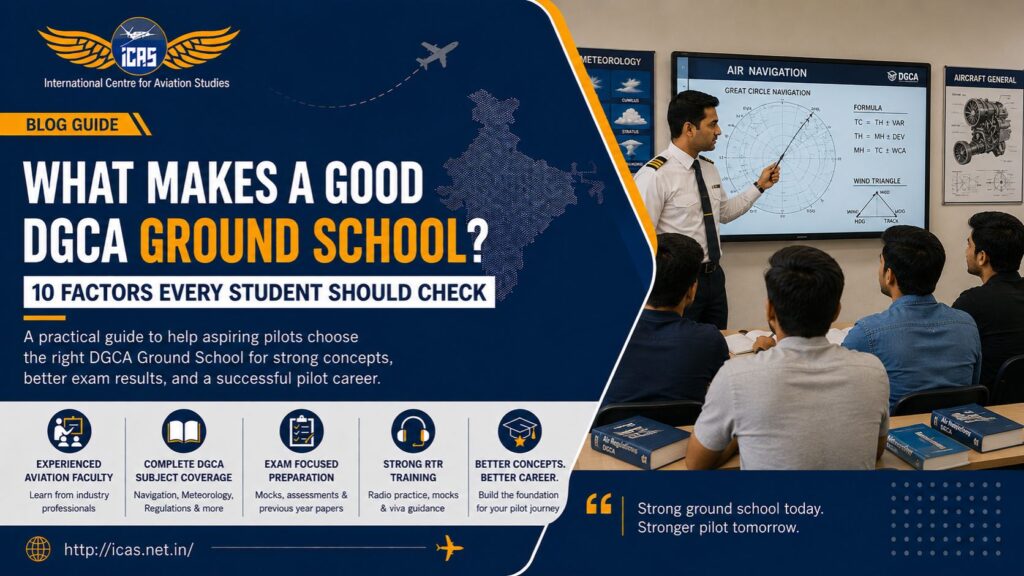
If you’re currently researching DGCA Ground School options in India, here are ten factors that deserve careful consideration before making a decision.
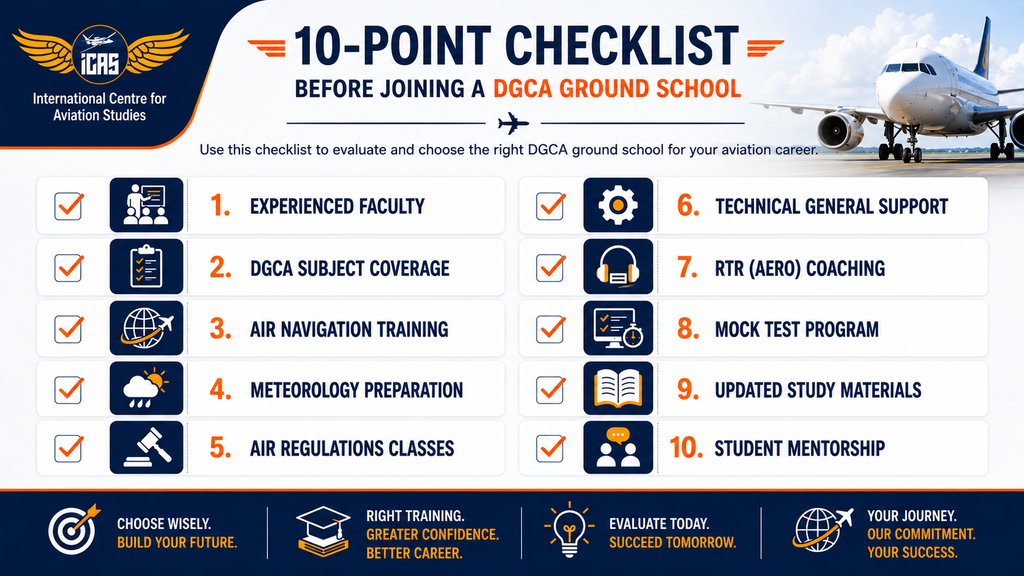
Faculty Should Have Real Aviation Experience, Not Just Teaching Experience
Aviation is not a subject that can be taught effectively through textbooks alone.
When an instructor explains drift correction in navigation, weather interpretation, aircraft systems, or radio communication procedures, practical aviation exposure makes a significant difference. Concepts become easier to understand when they are connected to real operational scenarios.
Look for faculty members who have experience as pilots, aviation instructors, airline professionals, military aviators, or subject matter specialists who understand how theoretical knowledge applies in actual flight operations.
Students often remember examples from experienced instructors long after they forget formulas and definitions.
The Ground School Should Focus on Concepts, Not Memorization
One of the biggest mistakes students make is choosing a coaching centre that teaches only from question banks.
While solving previous DGCA questions is important, aviation examinations are increasingly testing conceptual understanding rather than simple memorization.
For example:
- Understanding why pressure systems affect weather is more valuable than memorizing weather answers.
- Understanding navigation principles is more useful than memorizing calculations.
- Understanding regulations helps you apply them correctly rather than recalling isolated facts.
Strong conceptual teaching pays dividends throughout your CPL training and future airline career.
Structured Preparation for All DGCA Papers
A quality DGCA Ground School should provide a clear roadmap for every theoretical subject required during pilot training.
These typically include:
- Air Navigation
- Air Meteorology
- Air Regulations
- Technical General
- RTR (Aero) Preparation
The training should be structured, progressive, and aligned with current DGCA examination requirements.
A common red flag is when institutes focus heavily on one subject while treating others as an afterthought.
A Serious Approach to RTR Preparation
Many students underestimate RTR (Aero) until they encounter the examination process.
Unlike DGCA written papers, RTR evaluates your ability to communicate confidently and professionally using standard aviation phraseology.
A good DGCA Ground School should provide:
- Regular radio telephony practice
- Mock viva sessions
- Communication drills
- Realistic examination scenarios
- Individual feedback sessions
Students who receive structured RTR training generally approach the examination with significantly greater confidence.
Regular Mock Tests Should Be Part of the Program
Knowledge alone does not clear DGCA examinations.
Students also need to become comfortable with:
- Time management
- Question interpretation
- Calculation speed
- Examination strategy
Frequent mock tests help identify weak areas early and allow students to refine their preparation before the actual examination.
Ground schools that conduct consistent assessments often produce more predictable student outcomes.
Updated Study Material Matters More Than Students Realize
Aviation is a highly regulated industry.
Regulations evolve. Examination patterns change. Procedures are updated.
The study material used by a DGCA Ground School should reflect the latest regulatory environment rather than relying on notes that have been circulated for years without revision.
Before enrolling, ask:
- How often are notes updated?
- Are students provided with digital resources?
- Are changes in DGCA requirements incorporated into training?
Current material reduces confusion and improves examination readiness.
Batch Size Can Influence Learning Quality
Large classrooms may appear impressive, but they often limit interaction.
DGCA subjects frequently involve calculations, interpretation, and detailed discussions. Students should feel comfortable asking questions whenever they encounter difficulties.
Smaller batches generally provide:
- Better faculty access
- Faster doubt resolution
- More personalized guidance
- Higher classroom engagement
In aviation education, quality interaction often matters more than classroom size.
The Institute Should Understand the Entire Pilot Training Journey
A good DGCA Ground School does more than prepare students for examinations.
Students frequently require guidance regarding:
- DGCA Class 1 and Class 2 Medicals
- Flight training options
- CPL requirements
- License conversion pathways
- Airline career progression
Institutes that understand the complete aviation ecosystem are often better positioned to mentor students effectively.
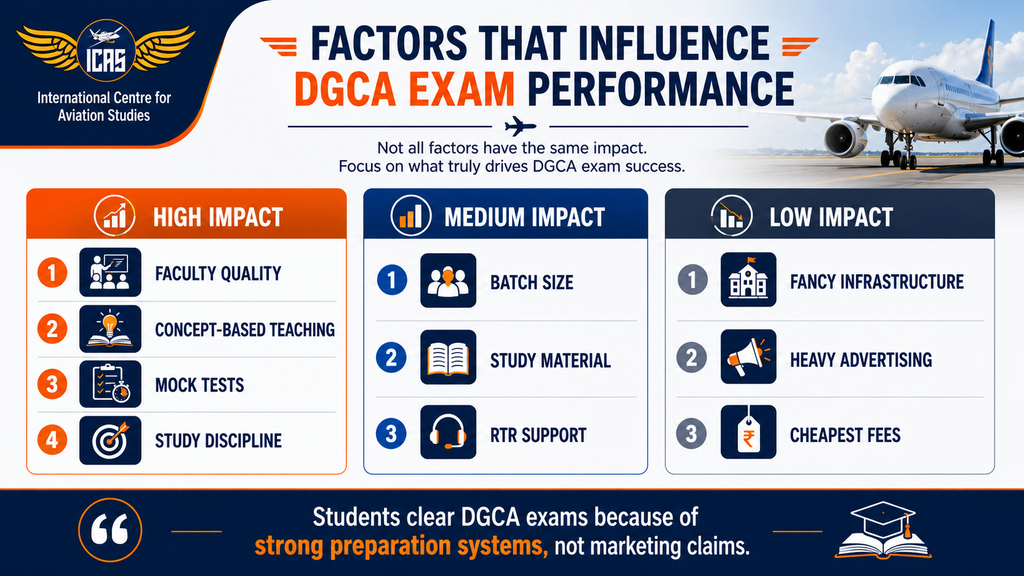
Look Beyond Marketing and Evaluate Student Outcomes
Social media advertisements can create a polished image, but student outcomes reveal the true quality of a training program.
Before joining, evaluate:
- DGCA examination success stories
- RTR clearances
- Student testimonials
- Alumni progress
- Industry reputation
Consistent results over several years usually indicate a strong academic system.
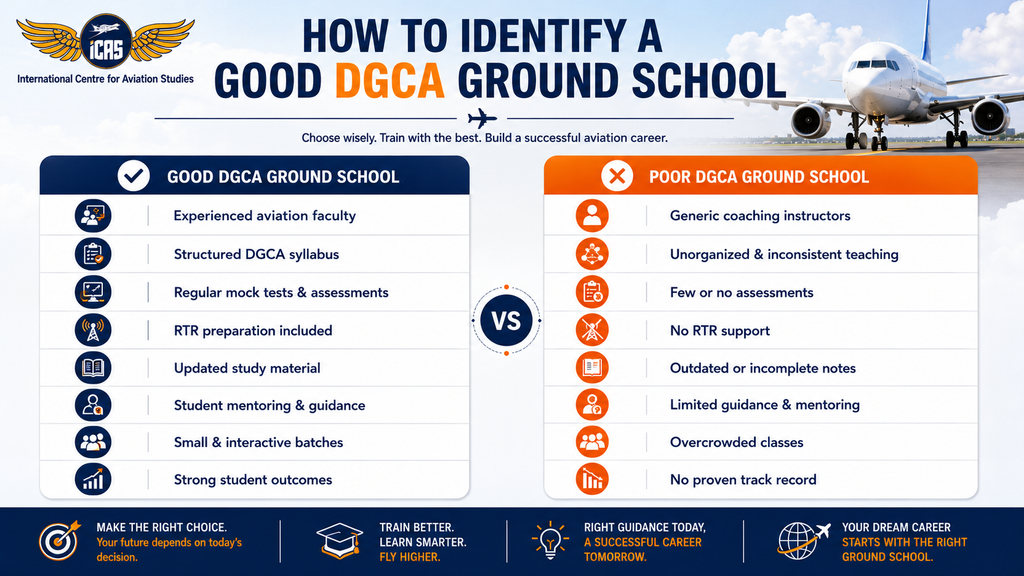
Choose Value, Not Just the Lowest Fee
Ground school fees are naturally an important consideration.
However, selecting a program solely because it is the cheapest option can become expensive if it leads to multiple exam attempts or delayed progress.
When comparing institutes, evaluate the complete package:
- Faculty expertise
- Learning resources
- Mock tests
- RTR support
- Student mentoring
- Academic assistance
The goal is not to find the cheapest DGCA Ground School. The goal is to find the one that prepares you most effectively for the next stage of pilot training.
🔗 Wondering how much training costs? Read our complete guide to Pilot Ground School Fees in India (2026).
Final Thoughts
A DGCA Ground School is much more than a classroom where students prepare for examinations. It is the environment where future pilots develop the theoretical knowledge, discipline, and aviation mindset that will support them throughout their careers.
The best ground schools are not necessarily the ones with the biggest advertisements or the lowest fees. They are the institutions that consistently help students understand concepts, clear examinations, succeed in RTR, and move confidently into flight training.
Before making your decision, spend time evaluating the faculty, teaching methodology, student outcomes, and level of support offered. The quality of your ground school can have a lasting impact on your journey from aspiring aviator to professional pilot.
🔗 Contact ICAS Academy of Aviation for expert guidance on your pilot training journey.