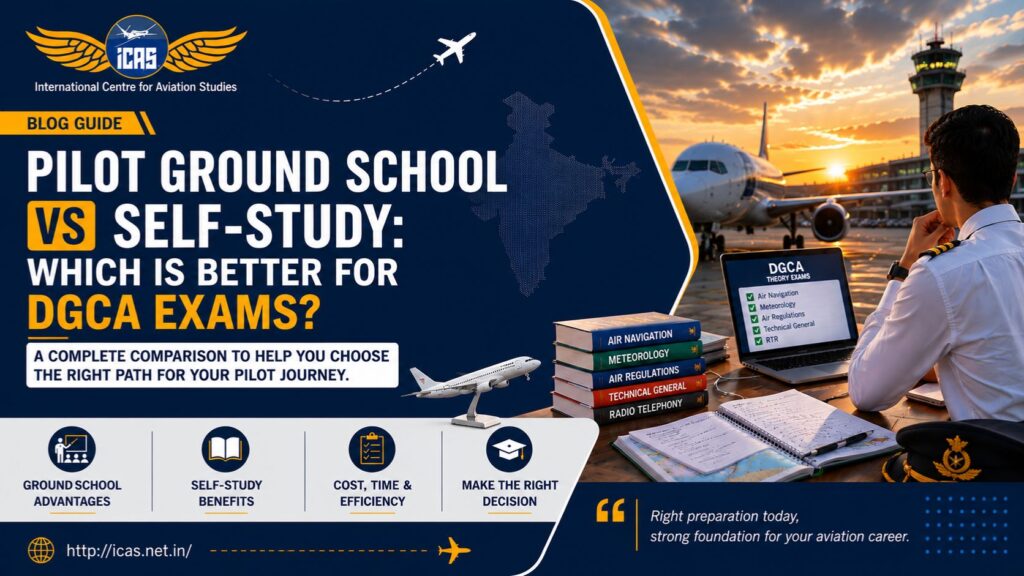
Every aspiring commercial pilot eventually faces the same question: should you join a pilot ground school or prepare for DGCA exams through self-study?
Both approaches have produced successful pilots. However, the right choice depends on factors such as your study discipline, aviation background, learning style, and timeline for completing DGCA examinations.
Before comparing the two approaches, it’s important to understand where DGCA theory preparation fits within the broader journey of becoming a commercial pilot.
🔗 If you want a step by step guide you can read our article on How to Become a Pilot in India (Step-by-Step Guide 2026)
Understanding What DGCA Exams Actually Demand
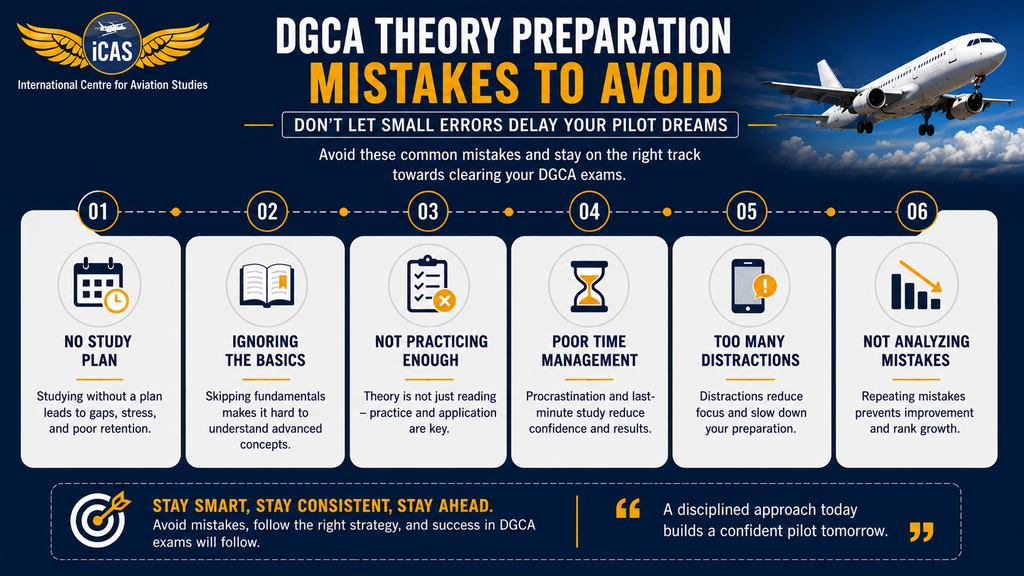
Many students begin their preparation assuming that DGCA theory papers are largely memory-based examinations. In reality, subjects such as Air Navigation, Meteorology, Air Regulations, and Technical General require conceptual understanding and consistent practice.
Navigation, for example, is often less about remembering formulas and more about applying principles under examination conditions. Similarly, Meteorology requires students to understand weather systems and their operational implications rather than simply memorizing definitions.
This is one reason why students often evaluate whether structured classroom training may offer an advantage over independent preparation.
The syllabus prescribed by the Directorate General of Civil Aviation (DGCA) is designed to build the theoretical foundation required for safe flight operations. Success therefore depends not only on how much you study, but also on how effectively you understand and apply aviation concepts.
What Is a Pilot Ground School?
A pilot ground school is a structured academic training programme designed to prepare aspiring pilots for DGCA examinations and subsequent flight training.
Most established ground schools provide:
- Subject-wise instruction
- DGCA-oriented study material
- Regular assessments
- Faculty guidance
- Performance monitoring
- Doubt-clearing sessions
- RTR preparation support
The goal is not just to cover the syllabus but to help students build the conceptual understanding required for both DGCA examinations and future flight training.
Pilot Ground School vs Self-Study: A Practical Comparison
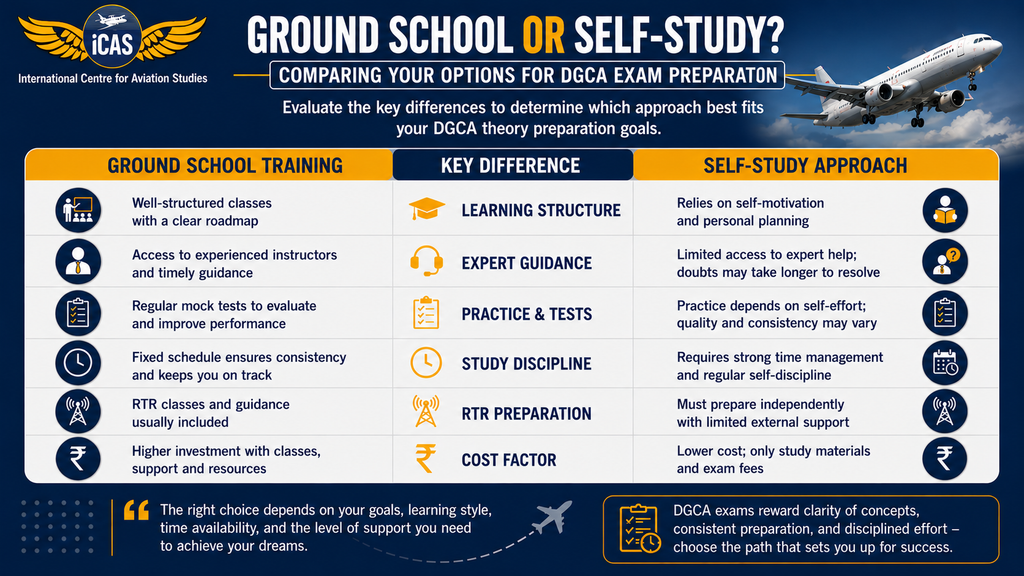
The differences become more apparent when students begin tackling technical subjects and preparing for multiple DGCA papers simultaneously.
| Factor | Pilot Ground School | Self-Study |
|---|---|---|
| Structured Learning | High | Depends on student |
| Faculty Guidance | Available | Limited |
| Mock Tests | Regular | Self-arranged |
| Study Discipline | Guided | Self-managed |
| RTR Preparation | Often Included | Independent |
| Flexibility | Moderate | High |
| Cost | Higher | Lower |
| Learning Environment | Collaborative | Individual |
Advantages of Joining a Pilot Ground School
Structured Learning Environment
One of the biggest benefits of a pilot ground school is the presence of a structured study plan. Instead of deciding what to study each day, students follow a systematic progression through the syllabus.
Access to Experienced Faculty
Experienced instructors can simplify difficult concepts and help students avoid common mistakes that repeatedly appear during DGCA examinations.
Regular Mock Tests
Consistent assessments allow students to identify weak areas long before the actual examination.
Better Accountability
Most students start preparation with enthusiasm. Maintaining that momentum over several months is often the bigger challenge. A classroom environment creates accountability that many self-study candidates struggle to replicate.
RTR Preparation Support
Many aspiring pilots underestimate the importance of RTR preparation until they begin the process. A structured ground school often provides guidance, mock sessions, and preparation strategies that can help students approach the examination with greater confidence.
Candidates can always refer to AIP uploaded on the Airports Authority of India (AAI) website for the route planning during their practice sessions.
Advantages of Self-Study
Self-study can be effective for students who are disciplined, organised, and comfortable learning independently. Its biggest advantages are flexibility and lower costs.
It can work particularly well for:
- Aviation graduates
- Students repeating individual subjects
- Candidates with previous DGCA exposure
- Learners who prefer independent study methods
The trade-off is accountability. Progress depends entirely on the student’s ability to stay consistent over several months of preparation.
Cost Considerations: Is Ground School Worth the Investment?
For many aspiring pilots, cost becomes one of the most important factors in the decision-making process.
Self-study generally requires a lower financial commitment, while professional ground school training involves tuition fees in addition to study materials and examination expenses.
Fees matter, but so do factors such as faculty access, study support, mock testing, RTR guidance, and overall preparation efficiency.
Those evaluating the financial aspect in greater detail may find it useful to review our Pilot Ground School Fees in India (2026) guide, which breaks down fee structures, course formats, and the factors that influence pricing across different institutes.
Choosing the Right Ground School Matters More Than Most Students Realise
A common mistake among aspiring pilots is assuming that every ground school delivers similar outcomes.
In reality, factors such as instructor quality, batch size, mentoring, study resources, and examination support can significantly influence a student’s preparation experience.
Students evaluating different institutes should understand what separates a strong training programme from an average one. Our guide on 10 Factors Every Student Should Check Before Starting a DGCA Ground School explores these considerations in detail.
Who Should Choose a Pilot Ground School?
A pilot ground school is generally a good fit for:
- First-time DGCA candidates
- Students preparing multiple subjects simultaneously
- Aspirants seeking faculty guidance
- Candidates requiring RTR preparation support
- Students working toward a faster and more structured completion timeline
Students looking for structured preparation, experienced faculty, mock testing, and RTR support can explore our Pilot Training Programs to better understand the available training pathways and learning formats.
Who Can Successfully Prepare Through Self-Study?
Self-study can be highly effective for candidates who possess:
- Strong self-discipline
- Effective time-management skills
- Previous aviation knowledge
- Access to quality study resources
- The ability to remain consistent without external accountability
Does a Pilot Ground School Guarantee Success?
No.
A pilot ground school can provide structure, guidance, and accountability, but it cannot replace personal effort.
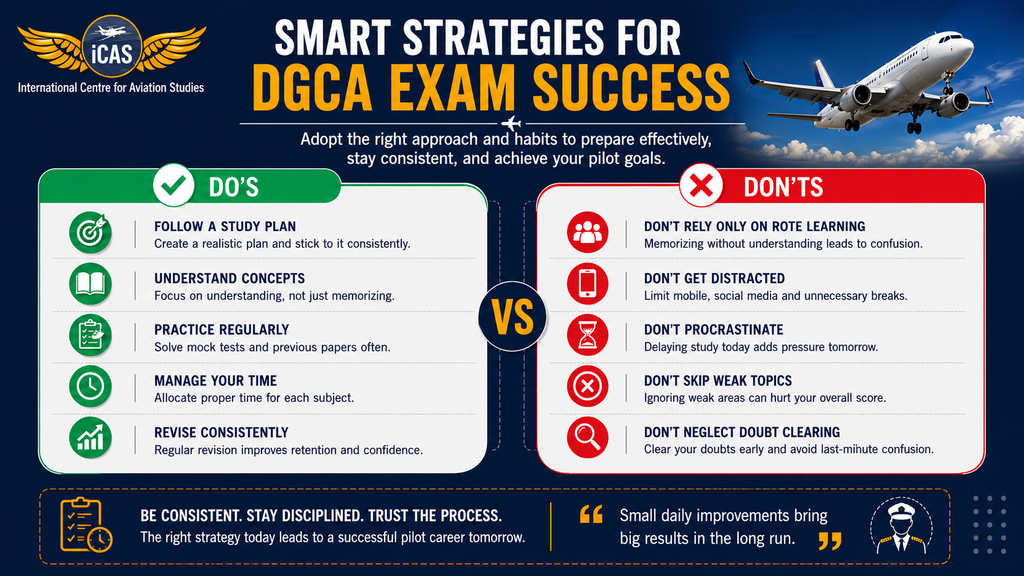
Students who revise consistently tend to perform well regardless of whether they study independently or through a structured programme.
Ultimately, success in DGCA examinations depends more on consistency than the study method itself.
Final Verdict
There is no universal answer to whether a pilot ground school is better than self-study.
For most first-time DGCA candidates, structured classroom training offers advantages through faculty guidance, mock testing, accountability, and organised preparation. For highly disciplined learners with strong study habits, self-study can also be a practical route.
Ultimately, DGCA examinations reward conceptual understanding, disciplined preparation, and consistent effort regardless of the path chosen.
If you’re still unsure which preparation route best suits your goals, timeline, or current level of aviation knowledge,
🔗 Contact Us for personalised guidance from our aviation training team.