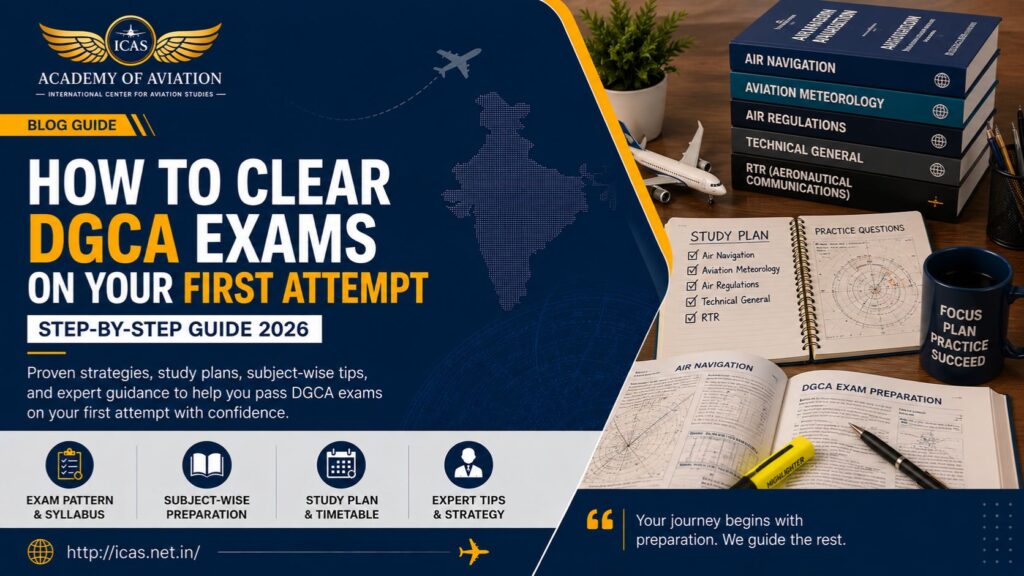
If you’re wondering how to clear DGCA exams on your first attempt, you’re not alone. For every aspiring commercial pilot in India, clearing DGCA examinations is one of the most important milestones on the journey to the flight deck. These examinations test the theoretical knowledge required to operate safely, make informed decisions, and meet the standards expected of professional pilots.
While many students worry about the difficulty of DGCA exams, success is usually determined by preparation strategy rather than intelligence alone. Students who understand the syllabus, study consistently, and follow a structured approach often perform significantly better than those who rely on last-minute preparation.
If you are wondering how to clear DGCA exams on your first attempt, this guide will help you understand the subjects, avoid common mistakes, and build an effective preparation strategy.
Before beginning your preparation, it is worth understanding the complete pathway to becoming a professional pilot. Our guide on how to become a pilot in India explains the training stages, licences, and qualifications required before starting your DGCA exam preparation.
What Are DGCA Exams?
The Directorate General of Civil Aviation (DGCA) is India’s aviation regulatory authority responsible for pilot licensing, aviation safety, and regulatory oversight.
Aspiring commercial pilots must clear the required DGCA examinations as part of the Commercial Pilot Licence (CPL) licensing process.
Students planning their aviation journey can also explore our Commercial Pilot Licence (CPL) training programme to understand how ground school training supports licence preparation and examination success.
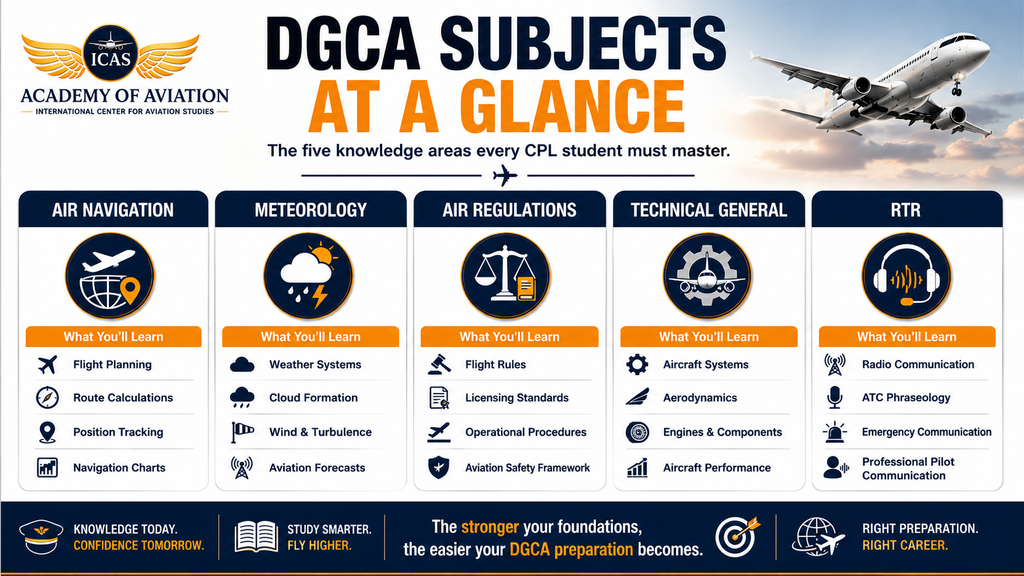
The primary DGCA subjects include:
Air Navigation
Air Navigation is often considered the most challenging DGCA subject because it combines calculations, chart work, flight planning, navigation systems, and operational concepts. Consistent practice is essential for mastering this subject.
Aviation Meteorology
Meteorology focuses on weather systems and their impact on aviation operations. Students learn about pressure systems, clouds, winds, visibility, turbulence, thunderstorms, and weather forecasting.
Air Regulations
This subject covers aviation laws, licensing requirements, operational rules, and regulatory frameworks that govern aviation activities.
Technical General
Technical General introduces students to aircraft systems, aerodynamics, engines, instruments, aircraft performance, and operational principles.
RTR Examination
The Radio Telephony Restricted (RTR) examination evaluates communication skills and radio procedures that pilots use during flight operations.
Students can access official examination information, schedules, and registration details through the official DGCA examination portal.
Why Students Struggle to Clear DGCA Exams
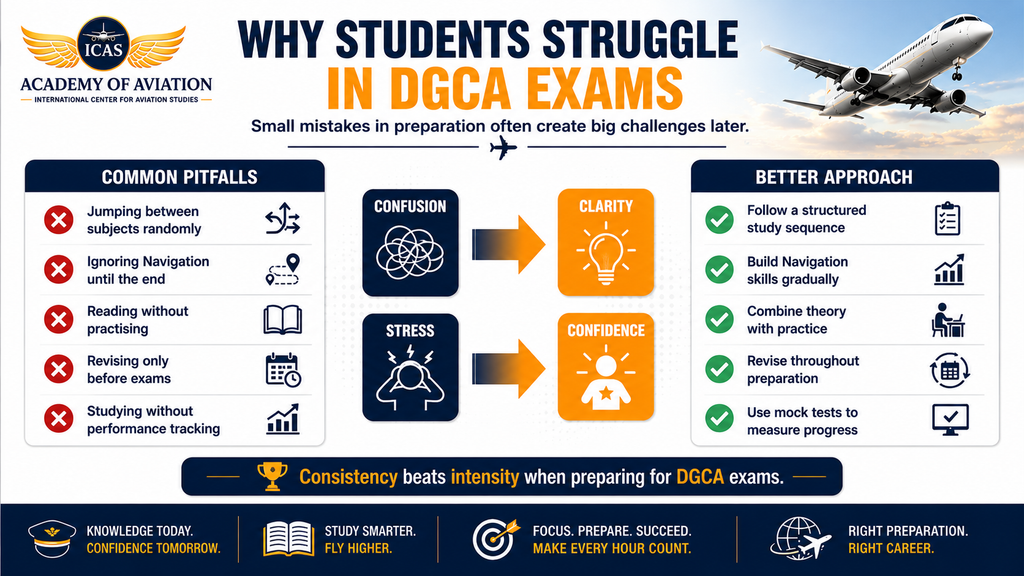
Understanding why students fail is often the first step toward understanding how to pass DGCA exams on the first attempt.
In most cases, students do not fail because the syllabus is impossible. They fail because their preparation lacks structure and consistency.
No Clear Study Plan
One of the most common mistakes is studying without a roadmap. Many students begin enthusiastically but quickly lose direction because they have not allocated time for each subject.
Without a study schedule, difficult subjects such as Navigation often get postponed until the last moment.
Weak Navigation Preparation
Navigation is calculation-heavy and requires continuous practice. Students who treat it like a theory subject often struggle during examinations.
Many candidates spend weeks reading concepts but very little time solving problems. This creates a gap between understanding and application.
Over-Reliance on Memorization
Subjects such as Meteorology and Air Regulations become much easier when concepts are understood properly.
Students who rely solely on memorizing answers often find themselves confused when questions are framed differently in the examination.
Poor Revision Habits
Learning new topics is important, but revision is equally critical.
Many students spend all their time covering new material while neglecting topics they studied earlier. As a result, they forget important concepts by the time examinations arrive.
Lack of Mock Tests
Mock examinations help students identify weak areas, improve time management, and become comfortable with examination pressure.
Students who never test themselves before the actual examination often underestimate the importance of speed and accuracy.
How to Clear DGCA Exams on Your First Attempt: A Practical Strategy
There is no secret formula for success. However, students who consistently follow a disciplined preparation strategy dramatically improve their chances of clearing DGCA exams on their first attempt.
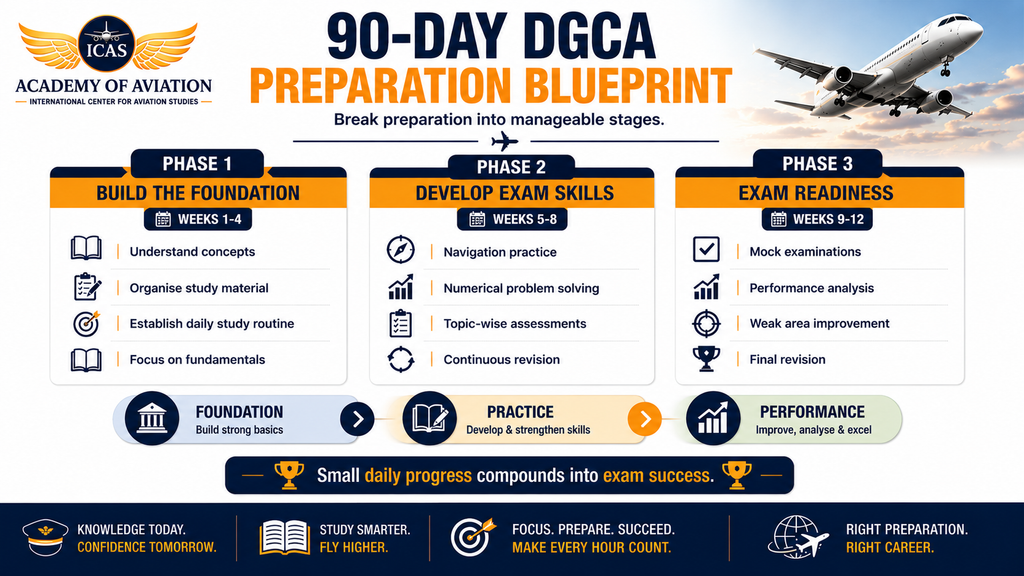
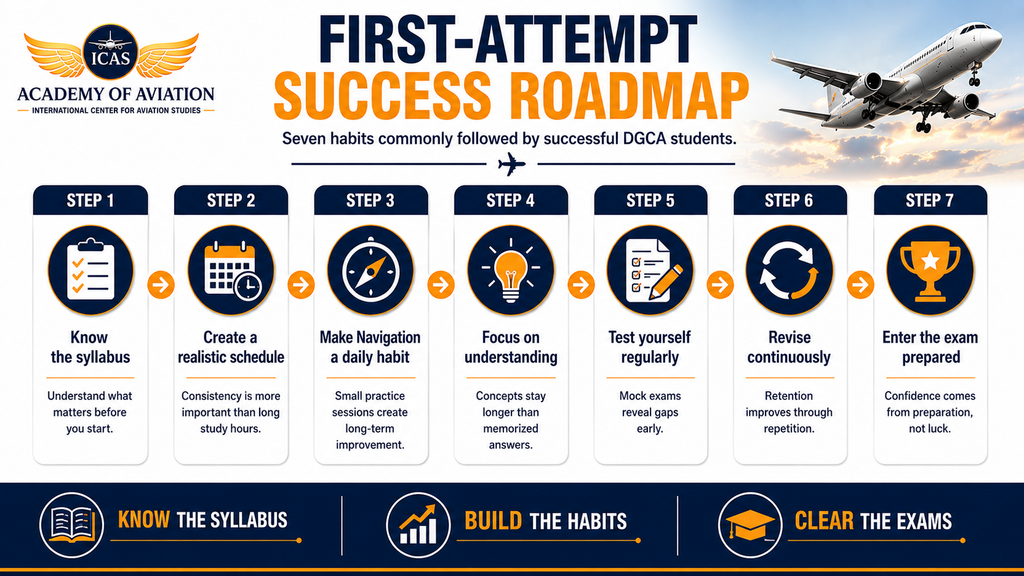
1. Understand the Syllabus Thoroughly
Before opening study material, spend time understanding exactly what you need to learn.
A clear understanding of the syllabus helps you:
- Prioritize important topics
- Allocate study time effectively
- Identify challenging areas early
- Avoid wasting time on irrelevant material
Students who understand the scope of each subject usually prepare more efficiently than those who study without direction.
2. Create a Realistic Study Plan
One of the biggest mistakes aspiring pilots make is creating unrealistic schedules that are impossible to follow consistently.
Instead of studying excessively for a few days and then burning out, focus on creating a routine that can be maintained over several months.
A practical study plan should include:
- Daily study sessions
- Weekly revision periods
- Dedicated Navigation practice
- Regular mock assessments
- Monthly progress reviews
Consistency is far more valuable than occasional bursts of intensive study.
Students often underestimate the financial and time commitment involved in ground training. Understanding pilot ground school fees in India can help you evaluate different training options and prepare accordingly.
3. Practice Air Navigation Every Day
If there is one subject that deserves special attention, it is Air Navigation.
Many students consider Navigation difficult because it combines theoretical understanding with practical problem-solving. However, students who practice consistently often find it much more manageable than expected.
Effective Navigation preparation includes:
- Daily numerical practice
- Chart interpretation
- Flight planning exercises
- Time-bound problem solving
- Reviewing previous mistakes
Even thirty minutes of focused Navigation practice every day can produce significant improvement over time.
4. Learn Meteorology Through Concepts
Meteorology becomes much easier when students focus on understanding rather than memorization.
Instead of simply remembering definitions, try to understand:
- How weather systems develop
- Why winds occur
- How clouds form
- How pressure affects aircraft operations
- Why turbulence develops
When students understand these concepts, they can answer a wider variety of questions with greater confidence.
5. Understand Regulations Instead of Memorizing Rules
Air Regulations often appears straightforward because it is theory-based. However, students frequently underestimate this subject and rely on memorization alone.
A better approach is to understand why regulations exist and how they contribute to aviation safety.
Many aviation standards are derived from international frameworks established by the International Civil Aviation Organization (ICAO)
Understanding the purpose behind regulations improves retention and makes revision significantly easier.
6. Attempt Mock Tests Regularly
Mock examinations are one of the most effective tools for improving performance before the actual DGCA exam.
Many students spend months studying but never test their knowledge under exam conditions. As a result, they struggle with time management, pressure, and question interpretation during the real examination.
Regular mock tests help you:
- Identify weak areas
- Improve speed and accuracy
- Build examination confidence
- Develop better time management
- Track progress objectively
Ideally, students should begin taking mock tests several weeks before their examination date rather than waiting until the final few days.
7. Revise Consistently
Revision is often the difference between passing and failing.
Many students focus heavily on learning new topics but spend very little time revisiting previously studied material. Over time, important concepts begin to fade, reducing overall performance.
A practical revision strategy includes:
- Weekly revision sessions
- Formula review sheets
- Mistake tracking notebooks
- Topic-wise summaries
- Regular self-assessments
Instead of revising everything at once before the examination, spread revision throughout your preparation period. This improves retention and reduces stress.
Students who understand how to clear DGCA exams early in their preparation journey often avoid many of the mistakes that lead to unnecessary exam attempts.
Subject-Wise Preparation Tips for DGCA Exams
Students researching how to clear DGCA exams often focus only on overall study plans, but subject-wise preparation is equally important.
While the overall preparation strategy remains the same, each DGCA subject requires a slightly different approach.
Air Navigation
Navigation rewards consistent practice more than any other subject.
To improve your performance:
- Practice calculations daily
- Solve problems under timed conditions
- Focus on accuracy before speed
- Review mistakes carefully
- Strengthen conceptual understanding before attempting advanced questions
Students who develop a daily Navigation routine generally find the subject much less intimidating.
Aviation Meteorology
Meteorology becomes easier when you connect theory with real-world weather conditions.
Focus on:
- Pressure systems
- Cloud formation
- Wind patterns
- Weather hazards
- Forecast interpretation
Understanding weather behaviour is more effective than memorizing definitions.
Air Regulations
For Air Regulations:
- Understand the purpose behind rules
- Focus on licensing requirements
- Revise operational procedures regularly
- Create concise revision notes
Students who understand aviation safety principles often retain regulatory concepts more effectively.
Technical General
Technical General requires strong fundamentals.
Concentrate on:
- Aircraft systems
- Engines
- Aerodynamics
- Flight instruments
- Aircraft performance
Diagrams and visual learning techniques can be particularly helpful for this subject.
Students seeking structured guidance should spend time choosing the right DGCA ground school before enrolling in any programme. The quality of instruction, study material, and academic support can significantly influence preparation outcomes.
Can You Clear DGCA Exams Without Coaching or Ground School?
Yes, many students successfully clear DGCA examinations through self-study every year.
However, success through self-study usually depends on several factors:
- Self-discipline
- Consistency
- Quality study material
- Effective revision habits
- Reliable doubt resolution
Students who are highly organized and motivated can perform well without formal coaching.
At the same time, many aspiring pilots prefer structured learning because it provides accountability, guidance, and a clear preparation roadmap.
If you are currently deciding between independent preparation and structured training, our comparison of pilot ground school vs self-study can help you evaluate which learning approach is better suited to your goals.
How a DGCA Ground School Can Improve Success Rates
A good ground school provides more than classroom instruction.
It creates a structured environment that helps students stay focused throughout their preparation journey.
Benefits often include:
- Systematic syllabus coverage
- Experienced instructors
- Scheduled assessments
- Mock examinations
- Academic mentorship
- Peer learning opportunities
While self-study works well for some students, many aspiring pilots find that a structured learning environment helps them stay accountable. A well-designed Commercial Pilot Licence (CPL) training programme provides a clear roadmap, instructor guidance, and regular assessments that keep preparation on track.
Many students also benefit from doubt-clearing sessions and course correction support, particularly when preparing for challenging subjects such as Navigation.
Common Mistakes to Avoid Before DGCA Exams
Even students with strong academic potential can struggle if they make avoidable preparation mistakes.
Some of the most frequent errors include:
- Starting preparation too late
- Ignoring Air Navigation practice
- Studying without a timetable
- Skipping revision sessions
- Avoiding mock examinations
- Depending entirely on question banks
- Neglecting weaker subjects
- Last-minute cramming
A balanced preparation strategy almost always produces better results than attempting to study everything during the final few weeks.
Frequently Asked Questions
Is it difficult to clear DGCA exams?
DGCA examinations require serious preparation, but they are manageable with a structured study plan, regular revision, and consistent practice.
How many months are needed to prepare for DGCA exams?
Preparation timelines vary from student to student. Most successful candidates spend several months building conceptual understanding and practicing regularly before attempting examinations.
Which DGCA subject is considered the most difficult?
Air Navigation is generally considered the most challenging subject because it combines calculations, chart work, and analytical problem-solving.
Can I clear DGCA exams through self-study?
Yes. Many students successfully clear DGCA examinations through self-study. However, structured training can help improve efficiency, consistency, and confidence.
Is coaching necessary to pass DGCA exams?
Coaching is not mandatory. However, many students find that instructor guidance, mock tests, and structured learning help them prepare more effectively.
Conclusion
Understanding how to clear DGCA exams successfully is not about studying longer hours than everyone else. It is about studying smarter, staying consistent, and following a structured preparation strategy.
Students who understand the syllabus, practice Navigation regularly, revise consistently, and evaluate their progress through mock tests place themselves in a strong position to succeed.
Whether you choose self-study or structured coaching, the key is to begin early, remain disciplined, and focus on continuous improvement throughout your preparation journey.
If you are exploring aviation training opportunities, browse our aviation training programmes to learn more about the pathways available for aspiring pilots.
If you would like personalised guidance on your DGCA preparation, you can also speak with our aviation counsellors through the Contact Us page.